

Verified NSE7_LED-7.0 dumps Q&As - Pass Guarantee Exam Dumps Test Engine [2025]
NSE7_LED-7.0 dumps and 63 unique questions
Fortinet NSE7_LED-7.0, also known as the Fortinet NSE 7 - LAN Edge 7.0 Exam, is a certification exam designed for IT professionals who are interested in becoming experts in the field of network security. NSE7_LED-7.0 exam covers a wide range of topics related to LAN edge security, including network infrastructure security, secure access, secure connectivity, and security management. It is a comprehensive exam that tests the knowledge and skills of IT professionals in securing LAN edge networks.
NEW QUESTION # 19
Refer to the exhibits showing AP monitoring information.
The exhibits show the status of an AP in a small office building. The building is located at the edge of a campus, and users are reporting issues with wireless network performance.
Which configuration change would best improve the wireless network performance?
- A. Select an alternative channel for the 5 GHz interface.
- B. Relocate the AP to be closer to the clients.
- C. Disable lower data rates on the 5 GHz interface.
- D. Enable band steering on the AP.
Answer: D
NEW QUESTION # 20
Refer to the exhibit. Examine the FortiGate user group configuration and the Windows AD LDAP group membership information shown in the exhibit.
FortiGate is configured to authenticate SSL VPN users against Windows AD using LDAP. The administrator configured the SSL VPN user group for SSL VPN users. However the administrator noticed that both the student and j.smith users can connect to SSL VPN.
Which change can the administrator make on FortiGate to restrict the SSL VPN service to the student user only?
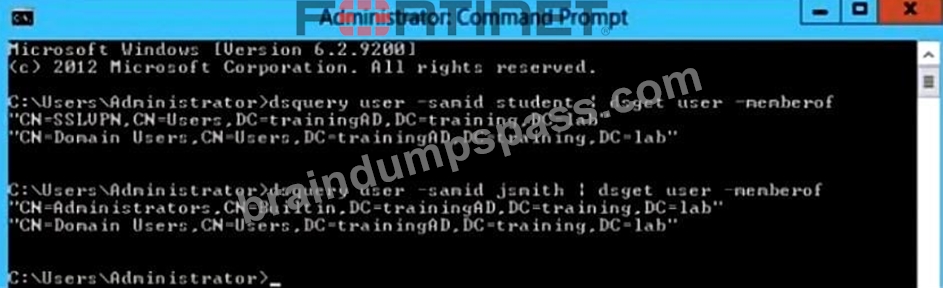
- A. In the SSL VPN user group configuration, set Group Name to CN=Domain Users,CN=Users,DC=trainingAD,DC=training,DC=lab.
- B. In the SSL VPN user group configuration, change Name to
CN=SSLVPN,CN=Users,DC=trainingAD,DC=training,DC=lab. - C. In the SSL VPN user group configuration, change Type to Fortinet Single Sign-On (FSSO).
- D. In the SSL VPN user group configuration, set Group Name to
CN=SSLVPN,CN=Users,DC=trainingAD,DC=training,DC=lab.
Answer: D
Explanation:
The Group Name is the name of the LDAP group that you want to use for authentication. The name must match exactly the name of the LDAP group on the LDAP server.
NEW QUESTION # 21
Refer to the exhibits.
Examine the debug output and the SSL VPN configuration shown in the exhibits.
An administrator has configured SSL VPN on FortiGate. To improve security, the administrator enabled Required Client Certificate on the SSL VPN configuration page. However, a user is unable to successfully authenticate to SSL VPN.
Which configuration change should the administrator make to fix the problem?
- A. Import the CA that signed the user certificate to FortiGate.
- B. Import the CA that signed the SSL VPN Server Certificate to FortiGate.
- C. Set the user certificate as the Server Certificate on the SSL VPN configuration page.
- D. Enable Redirect HTTP to SSL-VPN on the SSL VPN configuration page.
Answer: A
NEW QUESTION # 22
An administrator is testing the connectivity for a new VLAN The devices in the VLAN are connected to a FortiSwitch device that is managed by FortiGate Quarantine is disabled on FortiGate While testing the administrator noticed that devices can ping FortiGate and FortiGate can ping the devices The administrator also noticed that inter-VLAN communication works However intra-VLAN communication does not work Which scenario is likely to cause this issue?
- A. The FortiGate ARP table is missing entries
- B. Access VLAN is enabled on the VLAN
- C. The FortiSwitch MAC address table is missing entries
- D. The native VLAN configured on the ports is incorrect
Answer: B
NEW QUESTION # 23
Refer to the exhibit. Examine the FortiGate configuration, FortiAnalyzer logs, and FortiGate widget shown in the exhibit.
An administrator is testing the Security Fabric quarantine automation. The administrator added FortiAnalyzer to the Security Fabric, and configured an automation stitch to automatically quarantine compromised devices. The test device (10.0.2.1) is connected to a managed FortiSwitch device.
After trying to access a malicious website from the test device, the administrator verifies that FortiAnalyzer has a log for the test connection. However, the device is not getting quarantined by FortiGate, as shown in the quarantine widget.
Which two scenarios are likely to cause this issue? (Choose two.)
- A. FortiAnalyzer does not have a valid threat detection services license
- B. FortiAnalyzer does not consider the malicious website an indicator of compromise (IOC)
- C. The web filtering rating service is not working
- D. The device does not have FortiClient installed
Answer: A,B
Explanation:
According to the exhibits, the administrator has configured an automation stitch to automatically quarantine compromised devices based on FortiAnalyzer's threat detection services. However, according to the FortiAnalyzer logs, the test device is not detected as compromised by FortiAnalyzer, even though it tried to access a malicious website. Therefore, option B is true because FortiAnalyzer does not have a valid threat detection services license, which is required to enable the threat detection services feature. Option D is also true because FortiAnalyzer does not consider the malicious website an indicator of compromise (IOC), which is a criterion for identifying compromised devices.
NEW QUESTION # 24
Exhibit.
Refer to the exhibit showing a network topology and SSID settings.
FortiGate is configured to use an external captive portal However wireless users are not able to see the captive portal login page Which configuration change should the administrator make to fix the problem?
- A. Enable the captive-portal-exempt option in the firewall policy with the ID 12
- B. Enable NAT in the firewall policy with the ID 13.
- C. Remove the guest.portal user group in the firewall policy with the ID 12
- D. Add the FortiAuthenticator and WindowsAD address objects as exempt destinations services
Answer: D
Explanation:
Explanation
According to the exhibit, the network topology and SSID settings show that FortiGate is configured to use an external captive portal hosted on FortiAuthenticator, which is connected to a Windows AD server for user authentication. However, wireless users are not able to see the captive portal login page, which means that they are not redirected to the external captive portal URL. Therefore, option B is true because adding the FortiAuthenticator and WindowsAD address objects as exempt destinations services will allow the wireless users to access the external captive portal URL without being blocked by the firewall policy. Option A is false because enabling NAT in the firewall policy with the ID 13 will not affect the redirection to the external captive portal URL, but rather the source IP address of the wireless traffic. Option C is false because enabling the captive-portal-exempt option in the firewall policy with the ID 12will bypass the captive portal authentication for the wireless users, which is not the desired outcome. Option D is false because removing the guest.portal user group in the firewall policy with the ID 12 will prevent the wireless users from being authenticated by FortiGate, which is required for accessing the external captive portal.
NEW QUESTION # 25
Refer to the exhibit.
Examine the IPsec VPN phase 1 configuration shown in theexhibit
An administrator wants to use certificate-based authentication for an IPsec VPN user Which three configuration changes must you make on FortiGate to perform certificate-based authentication for the IPsec VPN user? (Choose three)
- A. In the Authentication section of the IPsec VPN tunnel in the Method drop-down list select Signature and then select the certificate that FortiGate will use for IPsec VPN
- B. Import the CA that signed the user certificate
- C. In the IKE section of the IPsec VPN tunnel in the Mode field select Main (ID protection)
- D. Create a PKI user for the IPsec VPN user, and then configure the IPsec VPN tunnel to accept the PKI user as peer certificate
- E. Enable XAUTH on the IPsec VPN tunnel
Answer: A,B,E
Explanation:
Explanation
According to the FortiGate Administration Guide, "To use certificate-based authentication, you must configure the following settings on both peers: Select Signature as the authentication method and select a certificate to use for authentication. Import the CA certificate that issued the peer's certificate. Enable XAUTH on the phase 1 configuration." Therefore, options B, D, and E are true because they describe the configuration changes that must be made on FortiGate to perform certificate-based authentication for the IPsec VPN user.
Option A is false because creating a PKI user for the IPsec VPN user is not required, as the user certificate can be verified by the CA certificate. Option C is false because changing the IKE mode to Main (ID protection) is not required, as the IKE mode can be either Main or Aggressive for certificate-based authentication.
NEW QUESTION # 26
Which EAP method requires the use of a digital certificate on both the server end and the client end?
- A. EAP-TLS
- B. EAP-TTLS
- C. PEAP
- D. EAP-GTC
Answer: A
Explanation:
Explanation
According to the FortiGate Administration Guide, "EAP-TLS is the most secure EAP method. It requires a digital certificate on both the server end and the client end. The server and client authenticate each other using their certificates." Therefore, option D is true because it describes the EAP method that requires the use of a digital certificate on both the server end and the client end. Option A is false because EAP-TTLS only requires a digital certificate on the server end, not the client end. Option B is false because PEAP also only requires a digital certificate on the server end, not the client end. Option C is false because EAP-GTC does not require a digital certificate on either the server end or the client end.
NEW QUESTION # 27
Which two statements about FortiSwitchmanager are true1? (Choose two)
- A. FortiManager obtains the FortiSwitch status information by querying the FortiGate REST API every three minutes
- B. Any switch discovered or authorized on FortiGate must be added manually on FortiSwitch manager
- C. Per-device management is the default management mode on FortiManager
- D. If the administrator makes any changes on FortiSwitch manager they must also install those changes on FortiGate so that those changes are applied on the managed switches
Answer: A,D
Explanation:
Explanation
According to the FortiManager Administration Guide1, "FortiManager obtains the FortiSwitch status information by querying the FortiGate REST API every three minutes." Therefore, option B is true because it describes how FortiManager gets the information about the managed switches. According to the same guide2,
"If you make any changes in this module, you must install them on your managed device so that they are applied on your managed switches." Therefore, option C is true because it describes what the administrator must do after making any changes on FortiSwitch manager. Option A is false because central management is the default management mode on FortiManager, not per-device management. Option D is false because anyswitch discovered or authorized on FortiGate will be automatically added on FortiSwitch manager, not manually.
1: https://docs.fortinet.com/document/fortimanager/7.0.0/administration-guide/734537/fortiswitch-manager 2:
https://docs.fortinet.com/document/fortimanager/7.0.0/administration-guide/734537/fortiswitch-manager#fortisw
NEW QUESTION # 28 
Wireless guest users are unable to authenticate because they are getting a certificate error while loading the captive portal login page.This URL string is the HTTPS POST URL guest wireless users see when attempting to access the network using the web browser
Which two settings are the likely causes of the issue? (Choose two.)
- A. The wireless user's browser is missing a CA certificate
- B. The FortiGate authentication interface address is using HTTPS
- C. The user address is not in DDNS form
- D. The external server FQDN is incorrect
Answer: A,D
Explanation:
Explanation
According to the exhibit, the wireless guest users are getting a certificate error while loading the captive portal login page. This means that the browser cannot verify the identity of the server that is hosting the login page.
Therefore, option A is true because the external server FQDN is incorrect, which means that it does not match the common name or subject alternative name of the server certificate. Option B is also true because the wireless user's browser is missing a CA certificate, which means that it does not have the root or intermediate certificate that issued the server certificate. Option C is false because the FortiGate authentication interface address is using HTTPS, which is a secure protocol that encrypts the communication between the browser and the server. Option D is false because the user address is not in DDNS form, which is not related to the certificate error.
NEW QUESTION # 29
What is the purpose of enabling Windows Active Directory Domain Authentication on FortiAuthenticator?
- A. It enables FortiAuthenticator to use a Windows CA certificate when authenticating RADIUS users
- B. It enables FortiAuthenticator to use Windows administrator credentials to perform an LDAP lookup for a user search
- C. It enables FortiAuthenticator to register itself as a Windows trusted device to proxy authentication using Kerberos
- D. It enables FortiAuthenticator to import users from Windows AD
Answer: C
Explanation:
Windows Active Directory domain authentication enables FortiAuthenticator to join a Windows Active Directory domain as a machine entity and proxy authentication requests using Kerberos.
NEW QUESTION # 30
Refer to the exhibit. Examine the IPsec VPN phase 1 configuration shown in the exhibit. An administrator wants to use certificate-based authentication for an IPsec VPN user.
Which three configuration changes must you make on FortiGate to perform certificate-based authentication for the IPsec VPN user? (Choose three)
- A. Create a PKI user for the IPsec VPN user, and then configure the IPsec VPN tunnel to accept the PKI user as peer certificate
- B. In the Authentication section of the IPsec VPN tunnel in the Method drop-down list select Signature and then select the certificate that FortiGate will use for IPsec VPN
- C. Import the CA that signed the user certificate
- D. In the IKE section of the IPsec VPN tunnel in the Mode field select Main (ID protection)
- E. Enable XAUTH on the IPsec VPN tunnel
Answer: A,B,C
NEW QUESTION # 31
An administrator has configured an SSID in bridge mode for corporate employees All APs are online and provisioned using default AP profiles Employees are unable to locate the SSID to conned Which two configurations can the administrator verify? (Choose two)
- A. Verify that the Block Intra-SSID Traffic (intra-vap-privacy) option in the SSID configuration is disabled
- B. Verify that the SSID is manually applied on AP profiles for both 2 4 GHz and 5 GHz radios
- C. Verify that the SSID to an AP group that should be broadcasting the SSID is applied
- D. Verify that the broadcast SSID option is enabled in the SSID configuration
Answer: C,D
Explanation:
Explanation
According to the FortiAP Configuration Guide1, "To enable the SSID, you must select at least one channel for the radio. If no channels are selected, the SSID will not be enabled. You must also enable Broadcast SSID." Therefore, option A is true because the broadcast SSID option allows the SSID to be visible to wireless clients.
Option C is also true because the SSID must be applied to an AP group that contains the APs that should be broadcasting the SSID. According to the same guide1, "You can create AP groups and assign them to different locations or departments. You can then apply different settings, such as SSIDs, to each group." Option B is false because blocking intra-SSID traffic prevents wireless clients on the same SSID from communicating with each other, which is not related to broadcasting the SSID. Option D is false because the SSID can be applied to an AP group or a global profile, which will automatically apply to all APs, without manually configuring each AP profile.
NEW QUESTION # 32
Refer to the exhibit. In the wireless configuration shown in the exhibits, an AP is deployed in a remote site and has a wireless network (VAP) called Corporate deployed to it. The network is a tunneled network however clients connecting to a wireless network require access to a local printer. Clients are trying to print to a printer on the remote site but are unable to do so.
Which configuration change is required to allow clients connected to the Corporate SSID to print locally?

- A. Disable the Block Intra-SSID Traffic (intra-vap-privacy) setting on the SSID (VAP) profile
- B. Configure the printer as a wireless client on the Corporate wireless network
- C. Configure split-tunneling in the vap configuration
- D. Configure split-tunneling in the wtp-profile configuration
Answer: C
Explanation:
Split tunneling allows you to specify which traffic is tunneled to the FortiGate and which traffic is sent directly to the Internet. This can improve performance and reduce bandwidth usage.
Therefore, by configuring split-tunneling in the vap configuration, you can allow the clients connected to the Corporate SSID to access both the corporate network and the local printer.
NEW QUESTION # 33
Refer to the exhibit
Examine the sections of the configuration shown in the output
What action will FortiGate take when verifying the student certificate through OCSP?
- A. Reject the student certificate if the OCSP server replies that the student certificate status is unknown
- B. Not verify the OCSP server certificate
- C. Use the OCSP URL included in the student certificate to verify the student certificate
- D. Consider the student certificate status as valid if the OCSP server is unreachable
Answer: A
NEW QUESTION # 34
Refer to the exhibit.
An administrator wants to telnet into the S224EPTF19005867 switch over the FortiGate FortiLink interface.
Which configuration change should the administrator make?
- A. On the default local-access profile, add telnet to the list of allowed protocols for mgmt-allowaccess.
- B. On the default local-access profile, add telnet to the list of allowed protocols for internal-allowaccess.
- C. Factory reset the switch to enable telnet access.
- D. Enable telnet access on the FortiLink interface.
Answer: B
NEW QUESTION # 35
Which two statements about MAC address quarantine by redirect mode are true? (Choose two)
- A. The quarantined device is kept in the current VLAN
- B. The device MAC address is added to the Quarantined Devices firewall address group
- C. It is the default mode for MAC address quarantine
- D. The quarantined device is moved to the quarantine VLAN
Answer: A,B
Explanation:
MAC address quarantine by redirect mode allows you to quarantine devices by adding their MAC addresses to a firewall address group called Quarantined Devices. The quarantined devices are kept in their current VLANs, but their traffic is redirected to a quarantine portal.
NEW QUESTION # 36
Refer to the exhibits.
Exhibit.
Examine the troubleshooting outputs shown in the exhibits
Users have been reporting issues with the speed of their wireless connection in a particular part of the wireless network The interface that is having issues is the 2 4 GHz interface that is currently configured on channel 6 The administrator of the wireless network has investigated and surveyed the local RF environment using the tools available at the AP and FortiGate Which configuration would improve the wireless connection?
- A. Change the AP 2.4 GHz channel to 11
- B. Change the AP 2.4 GHz channel to 1.
- C. Change the AP 2.4 GHz channel to 9.
- D. Change the AP 2.4 GHz channel to 13.
Answer: B
Explanation:
According to the exhibits, the AP 2.4 GHz interface is currently configured on channel 6, which is overlapping with other nearby APs on channels 4 and 8. This can cause interference and reduce the wireless performance. Therefore, changing the AP 2.4 GHz channel to 1 would improve the wireless connection, as it would avoid the overlapping channels and use a non-overlapping channel instead. Option A is false because changing the AP 2.4 GHz channel to 11 would still overlap with other nearby APs on channels 9 and 13.
Option C is false because changing the AP 2.4 GHz channel to 9 would still overlap with other nearby APs on channels 6, 8, and 11. Option D is false because changing the AP 2.4 GHz channel to 13 would still overlap with other nearby APs on channels 9 and 11.
NEW QUESTION # 37
Refer to the exhibit.
Examine the network diagram and packet capture shown in the exhibit
The packet capture was taken between FortiGate and FortiAuthenticator and shows a RADIUS Access-Request packet sent by FortiSwitch to FortiAuthenticator through FortiGate Why does the User-Name attribute in the RADIUS Access-Request packet contain the client MAC address?
- A. FortiSwitch is sending a RADIUS accounting message to FortiAuthenticator
- B. The client is performing AD machine authentication
- C. FortiSwitch is authenticating the client using MAC authentication bypass
- D. The client is performing user authentication
Answer: C
Explanation:
Explanation
According to the exhibit, the User-Name attribute in the RADIUS Access-Request packet contains the client MAC address of 00:0c:29:6a:2b:3d. This indicates that FortiSwitch is authenticating the client using MAC authentication bypass (MAB), which is a method of authenticating devices that do not support 802.1X by using their MAC address as the username and password. Therefore, option B is true because it explains why the User-Name attribute contains the client MAC address. Option A is false because AD machine authentication uses a computer account name and password, not a MAC address. Option C is false because user authentication uses a user name and password, not a MAC address. Option D is false because FortiSwitch is sending a RADIUS Access-Request message to FortiAuthenticator, not a RADIUS accounting message.
NEW QUESTION # 38
Which two pieces of information can the diagnose test authserver ldap command provide? (Choose two.)
- A. It displays the LDAP codes returned by the LDAP server
- B. It displays whether the user credentials are correct
- C. It displays whether the admin bind user credentials are correct
- D. It displays the LDAP groups found for the user
Answer: B,D
NEW QUESTION # 39
Which two statements about FortiSwitch manager are true1? (Choose two)
- A. FortiManager obtains the FortiSwitch status information by querying the FortiGate REST API every three minutes
- B. Any switch discovered or authorized on FortiGate must be added manually on FortiSwitch manager
- C. Per-device management is the default management mode on FortiManager
- D. If the administrator makes any changes on FortiSwitch manager they must also install those changes on FortiGate so that those changes are applied on the managed switches
Answer: A,D
Explanation:
According to the FortiManager Administration Guide1, "FortiManager obtains the FortiSwitch status information by querying the FortiGate REST API every three minutes." Therefore, option B is true because it describes how FortiManager gets the information about the managed switches. According to the same guide2,
"If you make any changes in this module, you must install them on your managed device so that they are applied on your managed switches." Therefore, option C is true because it describes what the administrator must do after making any changes on FortiSwitch manager. Option A is false because central management is the default management mode on FortiManager, not per-device management. Option D is false because any switch discovered or authorized on FortiGate will be automatically added on FortiSwitch manager, not manually.
1: https://docs.fortinet.com/document/fortimanager/7.0.0/administration-guide/734537/fortiswitch-manager 2:
https://docs.fortinet.com/document/fortimanager/7.0.0/administration-guide/734537/fortiswitch- manager#fortiswitch-manager
NEW QUESTION # 40
Which two pieces of information can the diagnose test authserver ldap command provide? (Choose two.)
- A. It displays the LDAP groups found for the user
- B. It displays the LDAP codes returned by the LDAP server
- C. It displays whether the user credentials are correct
- D. It displays whether the admin bind user credentials are correct
Answer: B,C
Explanation:
Explanation
According to the FortiGate CLI Reference Guide, "The diagnose test authserver ldap command tests LDAP authentication with a specific LDAP server. The command displays whether the user credentials are correct and whether the user belongs to any groups that match a firewall policy. The command also displays the LDAP codes returned by the LDAP server." Therefore, options B and C are true because they describe the information that the diagnose test authserver ldap command can provide. Option A is false because the command does not display whether the admin bind user credentials are correct, but rather whether the user credentials are correct. Option D is false because the command does not display the LDAP groups found for the user, but rather whether the user belongs to any groups that match a firewall policy.
NEW QUESTION # 41
To troubleshoot configuration push issues on a managed FortiSwitch, which FortiGate process should an administrator enable debug for?
- A. flcfgd
- B. httpsd
- C. cu_acd
- D. fortilinkd
Answer: A
NEW QUESTION # 42
Refer to the exhibit. Examine the LDAP server configuration shown in the exhibit. Note that the Username setting has been expanded to display its full content.
On the Windows AD server 10.0.1.10, the administrator used dsquery, which returned the following output:
>dsquery user -samid student
"CN=student,CN=Users,DC=trainingAD,DC=training,DC=lab"
According to the output, which FortiGate LDAP setting is configured incorrectly?
- A. Username
- B. Distinguished Name
- C. Common Name Identifier
- D. Bind Type
Answer: B
Explanation:
According to the exhibits, the LDAP server configuration on FortiGate has the Distinguished Name set to "dc=training,dc=lab". However, according to the output of the dsquery command on the Windows AD server, the Distinguished Name of the domain should be
"dc=trainingAD,dc=training,dc=lab".
NEW QUESTION # 43
......
Fortinet NSE7_LED-7.0 is an exam that tests the skills and knowledge of network security professionals in deploying and managing Fortinet's LAN Edge solutions. NSE7_LED-7.0 exam is designed for individuals who have experience in managing and securing LAN infrastructure and are seeking to validate their skills in deploying and managing Fortinet's LAN Edge solutions. NSE7_LED-7.0 exam covers topics such as Fortinet's Secure SD-WAN, FortiGate, FortiManager, FortiAnalyzer, FortiSwitch, FortiAP, and FortiNAC.
NSE7_LED-7.0 Dumps for Pass Guaranteed - Pass NSE7_LED-7.0 Exam: https://www.braindumpspass.com/Fortinet/NSE7_LED-7.0-practice-exam-dumps.html
NSE7_LED-7.0 Exam Dumps - Try Best NSE7_LED-7.0 Exam Questions: https://drive.google.com/open?id=1PhjHnd4P7pP2Zv9NwbLsUAb42knGFC1x