

Get Prepared for Your Network-Security-Essentials Exam With Actual WatchGuard Study Guide!
Pass Your Next Network-Security-Essentials Certification Exam Easily & Hassle Free
NEW QUESTION # 12
You have just configured Mobile VPN with IKEv2 for your customer. By default, authenticated Mobile VPN users are allowed to send traffic to all Firebox networks through the VPN.
- A. True
- B. False
Answer: B
Explanation:
In the default configuration ofMobile VPN with IKEv2, authenticated VPN users are only allowed access to specified networks or resources as defined by the VPN policy. They do not automatically have access to all Firebox networks through the VPN. To enable access to specific networks, administrators need to configure access routes explicitly within the Mobile VPN settings.
NEW QUESTION # 13
What is true about this log message? (Select three.)
- A. The Gateway AntiVirus service denied the email traffic because it matches the 18.254 virus signature
- B. The HTTPS proxy identified a TLS v1.3 connection to the inbox.google.com SNI domain
- C. The traffic is allowed outbound through the Firebox
- D. The Application Control service has identified the traffic as Gmail
- E. The traffic is allowed inbound through the Firebox
Answer: B,C,D
Explanation:
Application Control Identifying Gmail Traffic: Application Control is capable of identifying and categorizing applications based on traffic patterns and signatures. In this case, it recognizes Gmail traffic, which is a typical function of Application Control for managing and monitoring web applications. This functionality allows administrators to monitor and control access to applications based on organizational policies.
HTTPS Proxy Identifies TLS v1.3 Connection: The HTTPS proxy in Firebox can inspect and manage encrypted traffic by recognizing details such as the Server Name Indication (SNI) field in TLS connections.
By identifying a TLS v1.3 connection to the inbox.google.com domain, the HTTPS proxy provides additional monitoring and control capabilities over encrypted connections.
Traffic Allowed Outbound Through the Firebox: Given that the log indicates outbound traffic, this confirms that the connection is permitted by the Firebox's policies for outbound traffic. Outbound traffic control is crucial for managing access to external resources and ensuring that only authorized traffic exits the network.
NEW QUESTION # 14
You want to create a branch office VPN virtual interface between a remote Firebox and your headquarters Firebox so the remote Firebox can send log data to a server at headquarters. For the log data to be sent from the remote Firebox over the VPN successfully, what BOVPN virtual interface setting must you configure?
(Select one.)
- A. Virtual IP addresses
- B. An IPSec certificate, instead of a Pre-shared key
- C. IKEv2 in the Phase 1 settings
- D. Perfect Forward Secrecy (PFS)
- E. Dead Peer Detection (DPD)
Answer: A
Explanation:
To enable the remote Firebox to send log data to a server at headquarters through a Branch Office VPN (BOVPN) virtual interface, you must configureVirtual IP addresses. Virtual IPs enable devices on either end of the VPN tunnel to communicate as if they are on the same network, facilitating routing of log data from the remote Firebox to the log server located at headquarters.
Other options likeIPSec certificatesandIKEv2are not specifically required for this configuration, though they can enhance security.Dead Peer Detection (DPD)andPerfect Forward Secrecy (PFS)are useful for maintaining VPN stability and security but are not directly necessary for enabling log transmission.
NEW QUESTION # 15
As you troubleshoot a Branch Office VPN tunnel, you see the log message below. Which settings can you modify in the BOVPN virtual interface configuration to resolve this issue? (Select one.)
- A. VPN Routes
- B. Phase 1 Settings
- C. BOVPN-Allow policies
- D. Gateway Settings
- E. Phase 2 Settings
Answer: E
Explanation:
When troubleshooting a Branch Office VPN (BOVPN) tunnel, issues in thePhase 2 settingscan commonly cause connectivity problems. Adjusting settings such as the encryption and integrity algorithms, or setting correct lifetimes in Phase 2, may resolve compatibility or timeout issues with third-party VPN endpoints. This configuration ensures the two VPN endpoints can securely exchange data in alignment with each other's capabilities and settings.
NEW QUESTION # 16
What does a Firebox configured with default firewall policies do with outbound traffic that does not have a configured route? (Select one.)
- A. Denies the traffic
- B. Sends the traffic to the default gateway
- C. Sends the traffic to the loopback interface
- D. Drops the traffic
Answer: D
Explanation:
When a Firebox is configured with default firewall policies and encounters outbound traffic that lacks a specified route, the Firebox will drop this traffic. In firewall configurations, if there's no matching route or policy, the traffic typically gets discarded by default to prevent unintended data leakage or unauthorized connections. This behavior is standard for most firewall devices to ensure secure handling of unconfigured paths.
NEW QUESTION # 17
You enable a network device monitoring application on a server with IP address 10.0.1.22. After you run the application, it reports that it cannot ping the Firebox at 10.0.1.1, and you see this log message in Traffic Monitor. What is the most likely cause of this issue? (Select one.)
- A. The dynamic NAT statement is not configured correctly for the 10.0.1.0/24 subnet
- B. There is no policy that allows Ping traffic from the server to the Firebox alias
- C. The default Unhandled Internal Packet policy is at the top of the policy set
- D. The server IP address is on the Blocked Sites list
- E. There is no route on the Firebox for the 10.0.1.0/24 subnet
Answer: B
Explanation:
The most likely reason for the network device monitoring application's failure to ping the Firebox is the absence of an explicit policy permitting Ping traffic from the server (IP 10.0.1.22) to the Firebox alias (10.0.1.1). By default, Firebox policies are configured to allow only traffic explicitly permitted by a policy.
Therefore, without a dedicated policy allowing ICMP (Ping) requests from this specific source to the Firebox, the device will drop the traffic, resulting in a connectivity failure for Ping.
This is a common scenario in Firebox configurations, where restrictive policy settings enhance network security by blocking all traffic types unless specifically allowed.
NEW QUESTION # 18
When you migrate a configuration file from one Firebox to a new Firebox, which settings transfer to the new device? (Select two.)
- A. Management users
- B. Feature key
- C. Policies
- D. DNS servers
- E. Certificates
Answer: A,C
Explanation:
When migrating configurations:
* Option A: Management user settings transfer, preserving administrator access control configurations on the new device.
* Option C: Policies, including firewall rules, transfer, ensuring that network traffic handling settings are retained.
* Option B(Certificates) andOption D(DNS servers) are specific configurations often set manually and do not automatically transfer.
* Option E(Feature key) is unique to each device and must be installed separately on the new Firebox.
NEW QUESTION # 19
If a Firebox has two trusted interfaces enabled, the default policies allow HTTPS connections between computers on different trusted networks.
- A. True
- B. False
Answer: B
Explanation:
By default, Firebox policies do not allow HTTPS connections between devices on separate trusted networks without specific policy configuration. Firebox's default security posture is to restrict inter-network traffic unless explicitly permitted, enhancing network segmentation and security within trusted zones.
NEW QUESTION # 20
After you enable content inspection, your users see a certificate warning when they browse the Internet. What is one way to resolve this? (Select one.)
- A. Import a trusted web server certificate to the Firebox
- B. Configure a WebBlocker exception for your certificate server
- C. Configure the HTTPS proxy policy to allow inbound traffic from your CA
- D. Install the current Firebox Proxy Authority certificate on your user workstations
Answer: D
Explanation:
When content inspection is enabled on a Firebox, it decrypts HTTPS traffic for inspection, which requires presenting its own certificate to the client devices. This often causes certificate warnings in web browsers because the certificate issued by the Firebox is not inherently trusted by the client browsers. To resolve this, you need to install the Firebox'sProxy Authority certificateon each user's workstation as a trusted certificate. This action will prevent browsers from displaying certificate warnings, as they will recognize the Firebox certificate as a trusted source for secure connections.
NEW QUESTION # 21
There is an Internet outage at your primary ISP, but the Internet connection from the Firebox has not failed over to your backup ISP. Both ISP connectors are correctly cabled and have active physical links. What could cause this problem? (Select two.)
- A. In the Multi-WAN settings, the Immediate Fallback option is enabled
- B. In the Multi-WAN settings, the Gradual Fallback option is enabled
- C. The secondary IP addresses are not defined for the backup ISP interface
- D. Link Monitor target for the backup ISP interface is not responding
- E. The Link Monitor target for the primary ISP interface is set to ping the default gateway, but the outage is further upstream
Answer: D,E
Explanation:
* Link Monitor Target for Backup ISP: If the backup ISP's Link Monitor target is not responsive, the Firebox will not initiate a failover, as it interprets the backup connection as inactive or faulty.
* Primary ISP Link Monitor Configuration: When the Link Monitor for the primary ISP only checks the default gateway, it may not detect issues occurring further upstream. If the outage is beyond the gateway, failover will not activate because the monitor assumes the link is still valid.
These settings are critical to ensuring proper Multi-WAN failover behavior in case of ISP issues.
NEW QUESTION # 22
Which of the following management interfaces can provide real-time diagnostic information? (Select two.)
- A. Log and Report Server
- B. Dimension
- C. Firebox System Manager
- D. Fireware Web UI
- E. Policy Manager
Answer: C,D
Explanation:
The Firebox System Manager (FSM) and Fireware Web UI are two key interfaces in Firebox devices for local management that offer real-time diagnostic information.
* Firebox System Manager (FSM): FSM provides a graphical interface that allows administrators to monitor traffic in real-time, view logs, and analyze performance metrics directly from the device. This interface includes specific tools such as Traffic Monitor and Subscription Services, which display current activity and status of security services, respectively. FSM is highly effective in immediate diagnostics due to its continuous update capabilities.
* Fireware Web UI: Fireware Web UI, another management interface available in Firebox, offers similar diagnostic functionalities but is accessible through a web browser. This interface is essential for remote diagnostics and provides real-time views on device status, traffic, and security service health.
The Web UI is particularly beneficial for quick access without needing specialized client software like FSM, making it convenient for on-the-go monitoring.
These two interfaces are central to Firebox management and are designed to streamline real-time monitoring and diagnostics, ensuring network health is visible and manageable at all times.
NEW QUESTION # 23
Based on the configuration shown in this image, clients on the network can successfully connect tohttps://www.watchguard.com.
- A. False
- B. True
Answer: B
Explanation:
Based on the configuration shown in the image, the HTTPS-proxy-out policy allows traffic fromAny-Trusted andAny-Optionalnetworks toAny-Externaldestination on port443(which is the standard port for HTTPS).
This rule effectively permits outbound HTTPS connections from clients within the trusted network to external HTTPS websites, such as https://www.watchguard.com.
Since the policy type isHTTPS-proxy, it can inspect and manage HTTPS traffic according to configured policies, but it does not block the connection itself. Therefore, users on the network should be able to successfully connect to external HTTPS sites.
NEW QUESTION # 24
To accurately detect applications over an HTTPS connection with Application Control, you must enable content inspection in the HTTPS proxy.
- A. False
- B. True
Answer: B
Explanation:
For Application Control to accurately detect and manage applications over HTTPS connections, content inspection must be enabled in the HTTPS proxy. This is because HTTPS encrypts application traffic, making it unreadable without decryption. By enabling content inspection, the HTTPS proxy can inspect and classify the application traffic within HTTPS sessions, allowing Application Control to function effectively on secure connections.
NEW QUESTION # 25
Which of these statements are true for this log message? (Select three.)
- A. Gateway AntiVirus detected a virus
- B. Application Control detected the application as a virus
- C. The URL path matched the proxy content type restrictions
- D. The connection used an HTTP Proxy
- E. The connection was denied
- F. The connection used an HTTP Packet Filter
Answer: A,D,E
Explanation:
Analyzing a typical Firebox log message for a denied connection with an associated virus detection involves recognizing multiple elements:
* HTTP Proxy Detection (C): If the connection utilized an HTTP proxy, this is typically noted in the log. Firebox's HTTP proxy is often used to inspect and manage web traffic, including scanning for malicious content.
* Gateway AntiVirus Detection (D): This service scans HTTP traffic for malware and will generate log messages if it identifies a virus. When a virus is detected, the action taken is generally to block the connection.
* Connection Denial (E): When a threat is detected (e.g., a virus via Gateway AntiVirus), Firebox policies are configured to deny the connection to prevent potential infection or data breaches. This is logged as a denied connection.
Other options, such as Application Control detecting a virus or the use of an HTTP Packet Filter, are not relevant in this context based on the function of HTTP proxies and Gateway AntiVirus in Firebox logs.
NEW QUESTION # 26
You routinely ship Fireboxes directly to remote offices without configuring them first. What is the zero-touch deployment method you can use to apply a configuration file after a Firebox arrives at a remote office? (Select one.)
- A. RapidDeploy
- B. WatchGuard System Manager
- C. Fireware Web UI
- D. Dimension Command
- E. Firebox Deployment Manager
Answer: A
Explanation:
When shipping Fireboxes to remote offices without pre-configuration, theRapidDeployfeature is designed to facilitate zero-touch deployment. RapidDeploy enables network administrators to apply a pre-configured setup file after the device arrives at its destination.
* Process of RapidDeploy: Administrators can upload a configuration file to the WatchGuard Cloud or another accessible location, from which the Firebox downloads its initial configuration upon connection. This method ensures that even with remote deployment, the Firebox will automatically configure itself based on predefined settings, eliminating the need for manual on-site setup.
* Advantages: RapidDeploy streamlines setup for large-scale, geographically distributed environments where physical access may be limited. This feature is specifically useful for organizations seeking a scalable, efficient deployment process for devices in remote locations.
NEW QUESTION # 27
Which of these is a valid host IP address in the subnet 10.0.1.0/24? (Select one.)
- A. 10.0.1.0/24
- B. 10.0.1.100/24
- C. 10.0.0.1/24
- D. 10.0.1.255/24
- E. 10.0.10.24/24
Answer: B
Explanation:
The subnet 10.0.1.0/24 has an IP range from10.0.1.1 to 10.0.1.254. In a /24 subnet:
* The first address (10.0.1.0) is thenetwork addressand cannot be assigned to a host.
* The last address (10.0.1.255) is thebroadcast addressand also cannot be assigned to a host.
OptionC (10.0.1.100/24)falls within the valid range for host addresses in the 10.0.1.0/24 subnet, making it the correct answer.
* Option A(10.0.10.24) is in a different subnet (10.0.10.0/24).
* Option B(10.0.1.255) is the broadcast address.
* Option D(10.0.0.1) is in a different subnet (10.0.0.0/24).
* Option E(10.0.1.0) is the network address.
NEW QUESTION # 28
You configured your Firebox as a DHCP server and want to verify the status of the leased addresses. You found this information in Firebox System Manager > Status Report. What is true about DHCP leases in this deployment? (Select two.)
- A. The hostname Server1 is associated with the IP address 10.20.1.100
- B. 252 IP addresses are currently available in the address pool for the 10.0.1.0/24 network
- C. The MAC address for the host using 10.0.1.2 is 00:50:56:9a:75
- D. DHCP leases for the 10.20.1.0/24 network are valid for 24 hours
- E. DHCP leases for the 10.0.1.0/24 network are valid for 8 hours
Answer: B,E
Explanation:
Analyzing the DHCP lease information from the provided image:
* Lease Duration for 10.0.1.0/24 Network:
* The lease for IP address 10.0.1.2 on interface eth1 starts at 2023/03/09 21:42:33 and ends at 2023
/03/10 05:42:33, showing a lease duration of 8 hours. Thus, DHCP leases for the 10.0.1.0/24 network are set to be valid for 8 hours.
* Available IP Addresses in 10.0.1.0/24 Pool:
* The summary indicates that 1 out of 253 IPs is leased for the 10.0.1.0/24 subnet, meaning 252 IPs remain available in the address pool.
These details confirm the correct answers:BandD.
Other options, such as MAC address and hostname associations, do not match the data provided in the image, making them incorrect choices. Let me know if you need further assistance analyzing DHCP configurations on Firebox devices.
NEW QUESTION # 29
What are some advantages of BOVPN virtual interfaces (route-based VPN) over classic policy-based BOVPNs? (Select two.)
- A. Increased BOVPN throughput
- B. Supports VPN connectivity to cloud services
- C. More flexible routing options
- D. Additional keep-alive options
- E. Additional encryption options
Answer: B,C
Explanation:
BOVPN virtual interfaces (route-based VPNs)offer several advantages over traditional policy-based BOVPNs:
* Supports VPN connectivity to cloud services (A): Route-based VPNs can more easily integrate with cloud environments, as they use routing rather than specific policies, making it possible to route traffic to various cloud services and manage cloud-based VPN connections.
* More flexible routing options (C): Route-based VPNs allow administrators to define more granular routing rules using standard IP routing tables. This flexibility supports complex network architectures and multiple routes for redundancy or load balancing.
These features make route-based VPNs more adaptable to modern network needs, particularly in hybrid and multi-cloud environments.
NEW QUESTION # 30
You configured your Firebox interfaces and routes and want to verify the status of the routes and connected hosts. You found this information in Firebox System Manager > Status Report. What is true about the IPv4 routes and ARP table in this deployment? (Select one.)
- A. The MAC address for 172.16.1.20 is 00:50:56:b0:22:0f
- B. 10.0.20.53 can be reached through the vlan20 interface
- C. The Firebox is publicly reachable at 198.51.100.1 through the eth0 interface
- D. The MAC address for the default gateway that currently routes traffic is 00:50:56:b5:e5:42
- E. The Firebox cannot resolve a MAC address for 10.0.1.32
Answer: C
Explanation:
Analyzing the routing table and ARP table in the provided image:
* Routing Table Analysis:
* The route 0.0.0.0 with a gateway of 198.51.100.1 on the eth0 interface suggests this is the default route for outbound traffic, indicating that the Firebox's public interface (eth0) is configured to route traffic through this gateway.
* This confirms that the Firebox is publicly reachable at the IP address 198.51.100.1.
* ARP Table Analysis:
* The ARP entry for the gateway IP 198.51.100.1 is not directly shown in the image but could typically be resolved to verify connectivity.
* Other options provided, such as MAC address validation, do not correspond with the current ARP entries shown in the image.
This setup indicates that the Firebox is accessible publicly on the eth0 interface using the IP 198.51.100.1, makingOption Athe correct answer.
NEW QUESTION # 31
What type of NAT enables clients on a private network to connect to servers on the Internet? (Select one.)
- A. Dynamic NAT
- B. Static NAT
- C. Hairpin NAT
- D. NAT loopback
Answer: A
Explanation:
Dynamic NAT enables clients on a private network to connect to servers on the Internet. By translating private IP addresses to a public IP address (or pool of addresses), Dynamic NAT allows multiple devices within a private network to access external resources on the Internet. This form of NAT is essential in conserving IP addresses and maintaining privacy for internal network topologies.
NEW QUESTION # 32
Some management tasks require you to use a specific management interface. Match the task below with the management interface that supports it.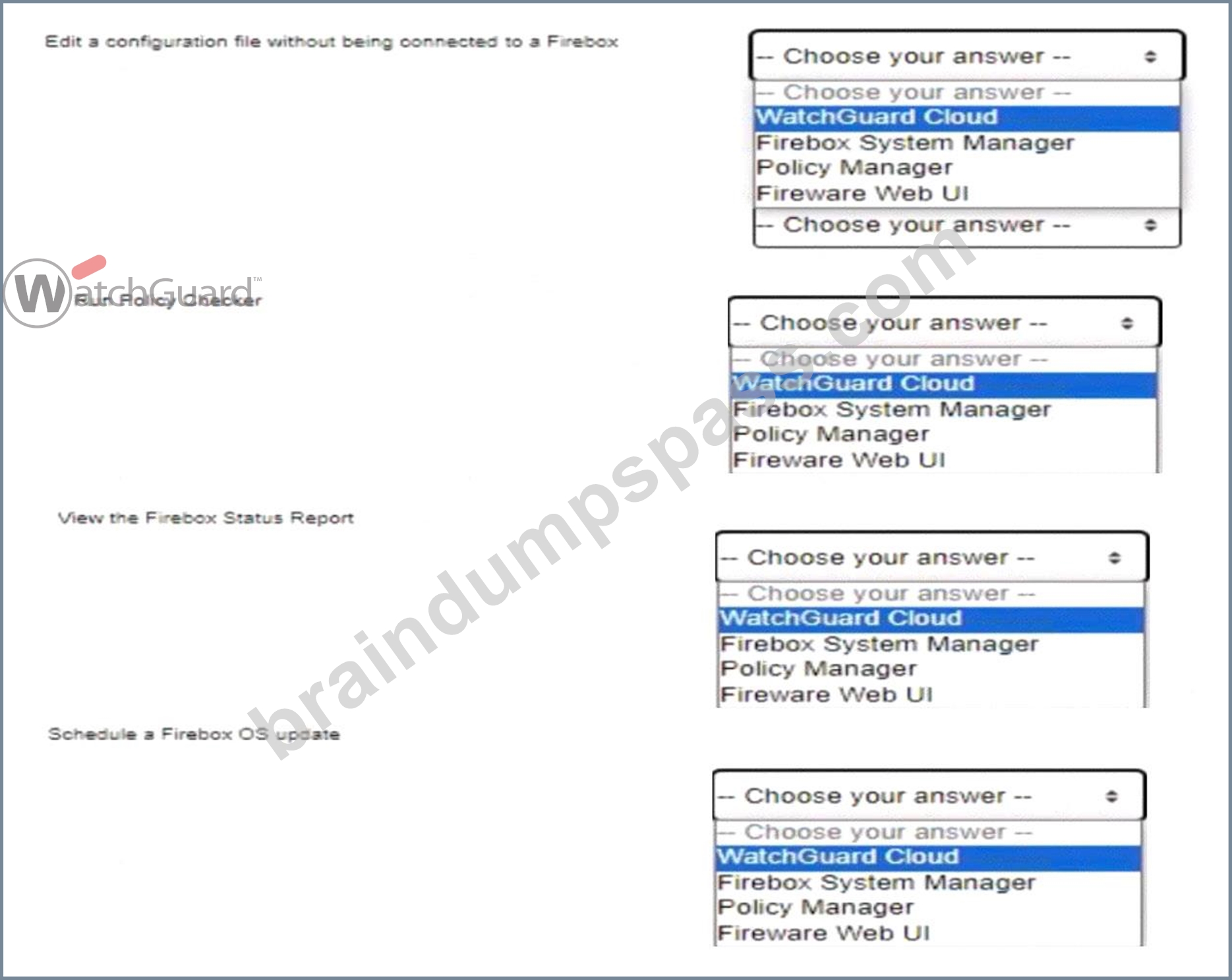
Answer:
Explanation:
Explanation:
Here are the correct answers based on typical Firebox management interface capabilities:
* Edit a configuration file without being connected to a Fireboxanswer: Policy Manager Policy Manager allows administrators to edit a Firebox configuration file offline without a direct connection to the Firebox. This feature is helpful for preparing configuration changes in advance.
* Run Policy Checkeranswer: Policy Manager
The Policy Checker tool is included in Policy Manager, which checks configuration settings for errors before applying them. This tool provides an essential layer of validation, preventing misconfigurations.
* View the Firebox Status Reportanswer: Firebox System Manager
The Firebox System Manager (FSM) interface provides real-time status reporting on device health, traffic, and security services, which includes viewing the Firebox Status Report.
* Schedule a Firebox OS updateanswer: Fireware Web UI
Fireware Web UI includes options for scheduling OS updates for the Firebox, which can be managed remotely through a web interface.
These answers align with standard Firebox network security essentials and their recommended management interfaces for specific administrative tasks. Let me know if you need further assistance with related Firebox management topics
NEW QUESTION # 33
You recently installed network monitoring software on your server and then performed a port scan for each IP address in the network. When the scan finishes, you notice that the server lost access to the Internet. What is the most likely cause of this issue? (Select one.)
- A. The server IP address was added to the Blocked Sites list because an IPS signature was matchedduring the port scan
- B. The policy that handles outbound traffic was automatically disabled because the Firebox was port scanned
- C. The server IP address was added to the Blocked Sites list because the network was flooded with ESP traffic during the port scan
- D. The server IP address was added to the Blocked Sites list because of the default packet handling port scan rule
- E. The port scan traffic matched a default HTTP proxy content type rule configured with a Block action
Answer: D
Explanation:
When a port scan is detected, Firebox devices with default settings often include a rule to add the source IP address of the scan to the Blocked Sites list to prevent potential threats. This is a standard security measure in Firebox configurations, aimed at mitigating the risk of network scanning attempts. Consequently, if the server you used to perform the port scan was added to the Blocked Sites list, it would lose Internet access as the device blocks any outgoing connections from that IP. This behavior aligns with Firebox's handling of port scan detection through default security rules.
NEW QUESTION # 34
Match the "network server to the protocol and port it uses."
Answer:
Explanation: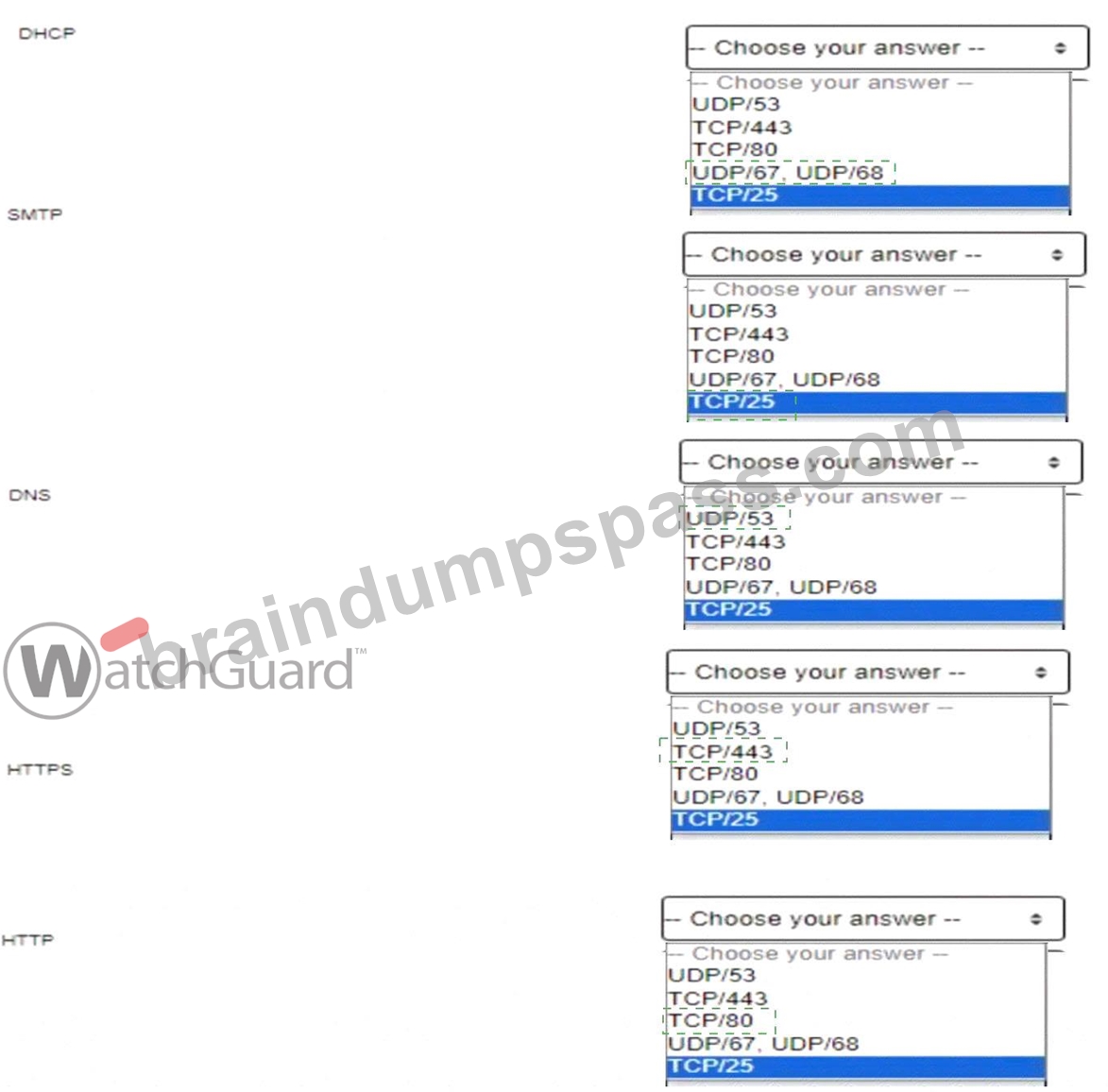
Explanation: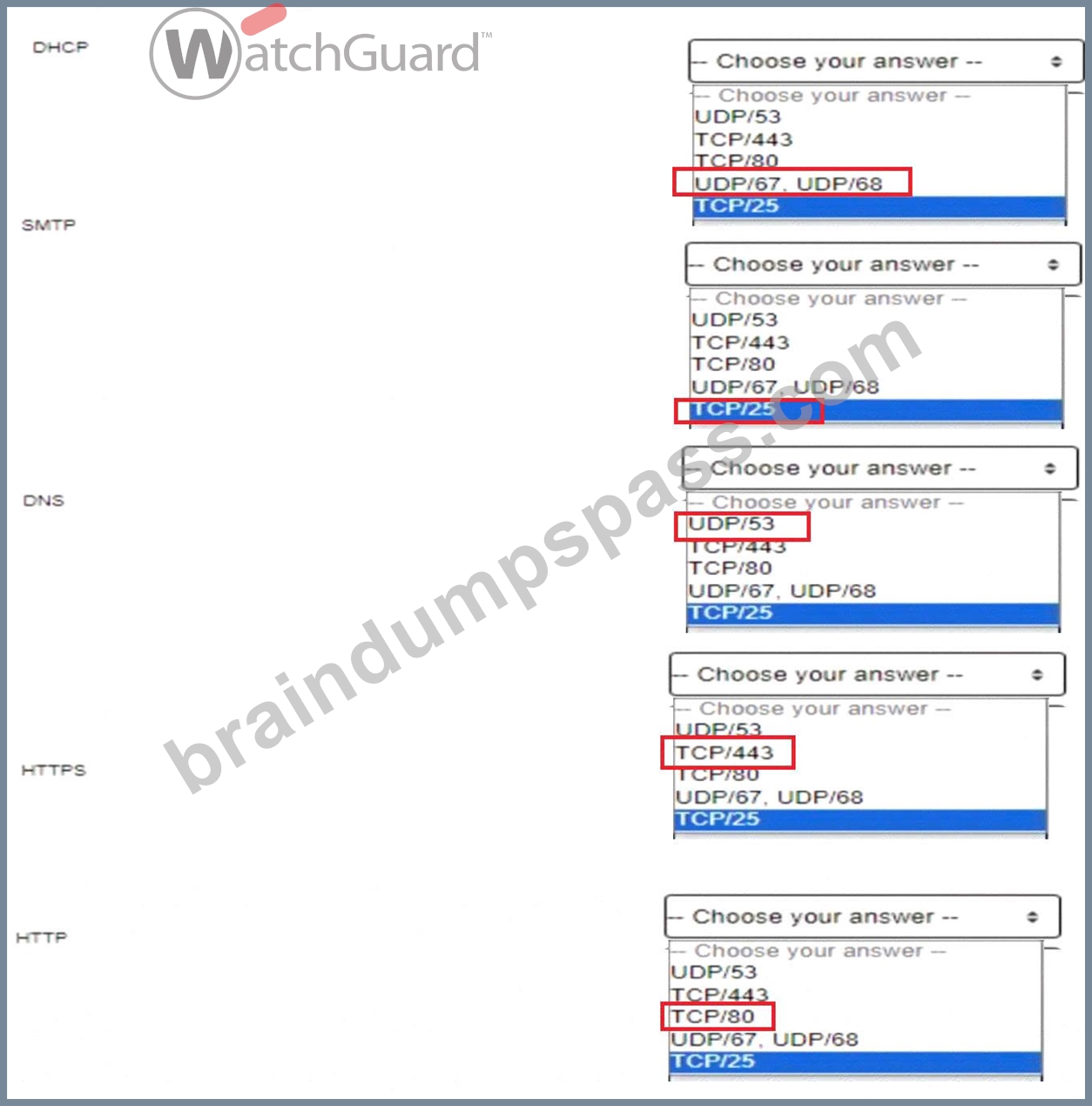
DHCP (Dynamic Host Configuration Protocol):DHCP operates over UDP ports 67 and 68. Port 67 is used by the DHCP server to listen for client requests, and port 68 is used by the DHCP client. This allows devices to automatically receive IP addresses and other network configuration details on a network, essential for automating IP management. [Referenced from multiple sources on network fundamentals] SMTP (Simple Mail Transfer Protocol):SMTP uses TCP port 25 for sending emails from client to server or between mail servers. SMTP is integral for email transmission, allowing efficient communication across mail servers within and outside organizational networks. [Referenced in standard protocols documentation in network management guides] DNS (Domain Name System):DNS typically runs on UDP port 53 for standard queries, with TCP/53 used for zone transfers and other larger requests. DNS is critical for resolving human-readable domain names into IP addresses, which allows users to connect to websites using easily remembered names rather than numerical IP addresses. [Foundational knowledge as detailed in network security and management resources] HTTPS (Hypertext Transfer Protocol Secure):HTTPS, an encrypted version of HTTP,operates on TCP port 443. It provides secure communication over the internet by encrypting data between the client and server using SSL/TLS, protecting data integrity and privacy. [Security essentials for network communications as found in secure web traffic documentation] HTTP (Hypertext Transfer Protocol):HTTP operates on TCP port 80 and is used for unencrypted web traffic. HTTP is the foundation of data exchange on the World Wide Web, supporting basic client-server interactions for retrieving resources from the web. [Basic networking knowledge referenced across multiple network essentials texts]
NEW QUESTION # 35
You configured a Firebox for a school environment. Students must have more restricted access than teachers, and unauthenticated users cannot have any Internet access. You added Student and Teacher groups to your proxy policies that handle web traffic. Based on the image below, this configuration can accomplish your goals.
- A. False
- B. True
Answer: B
Explanation:
The image shows a configuration for a school environment with separateHTTPandHTTPS proxy policiesfor StudentsandTeachers. This separation allows for different levels of access control based on group membership, providing more restrictive access for students compared to teachers.
* Studentsare restricted by specific HTTP and HTTPS proxy policies, limiting their access to designated content and sites.
* Teachershave their own policies, which can be configured with more permissive rules.
* Unauthenticated users are not included in any policy, effectively blocking their internet access, as the firewall denies traffic not explicitly allowed by a policy.
This configuration meets the requirements by:
* Allowing teachers and students access as per their respective policies.
* Blocking unauthenticated users from internet access entirely.
NEW QUESTION # 36
......
Ace Network-Security-Essentials Certification with 60 Actual Questions: https://www.braindumpspass.com/WatchGuard/Network-Security-Essentials-practice-exam-dumps.html
Free WatchGuard Network-Security-Essentials Exam Question Practice Exams: https://drive.google.com/open?id=1d8klbx31FDoOARMU2ssPH_PPdQOVIY59